Nomads

For generations, nomads— known as “Koçerler” in Kurdish—have lived on the plains between Ceylanpınar and Viranşehir in Şanlıurfa, Turkey. Long before the establishment of the Republic, they held land here and were offered title deeds. But decades later, their ancestral lands were absorbed into the Ceylanpınar State Production Farm, and the government now demands that they leave.

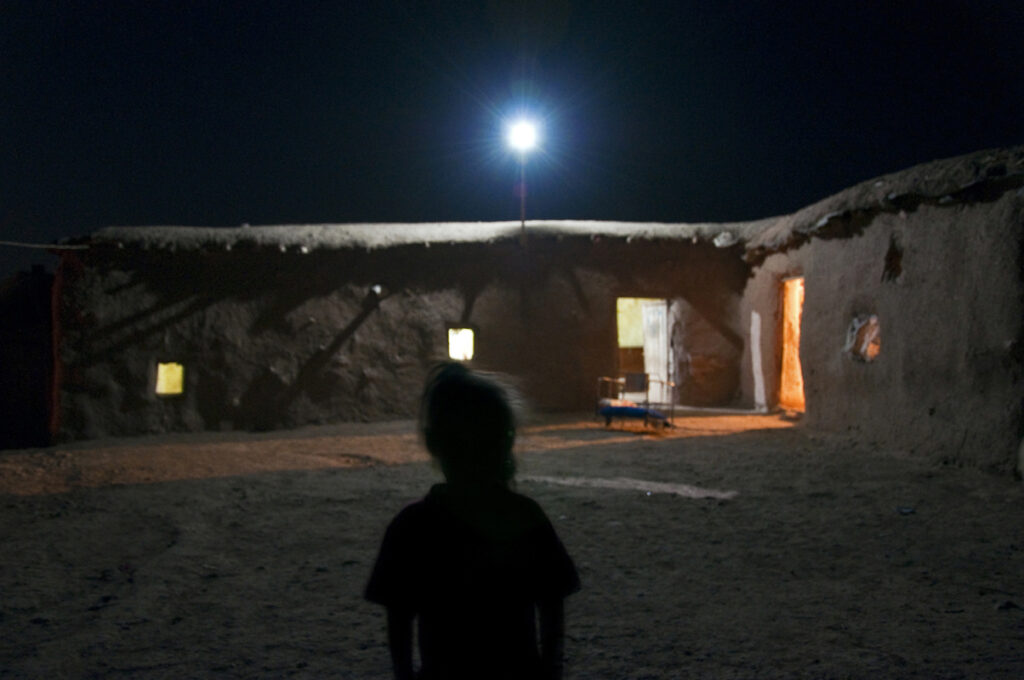
The Koçer refuse to go. They say this land holds their history—and the graves of their grandparents. In response, the state denies them municipal services and legal recognition, citing their “nomadic” status. No roads connect them to towns, and no public infrastructure supports them. Water is delivered by tank trucks. Solar panels, if affordable, power only the basics.

Women give birth without medical aid, cutting umbilical cords themselves, washing three children with just one bucket of water. With no schools in the area, children walk long distances to reach village schools—unless the river floods in winter, making travel impossible. The Koçer live not outside the system, but beneath it—claiming their rights while being denied them.

Sanliurfa, Turkey, August 2012

A story of human rights of Kurds in Turkey, 2012.
Şibliye Cluster. Anye Ateşli, Mehmet Ateşli. Sanliurfa, Turkey, 2012.
Keser el esved Cluster. Grandparents and grandchildren getting up in the morning.
Keser el esved Cluster.
Mangalan Cluster. The only source of income for the nomads is animal husbandry. They used to live as nomads for this reason, and they cannot leave their homes now for the very reason. “We can neither live like this nor leave our land and move to somewhere else” they say.
Civeme Cluster. Mingala game is being played with 98 stones. Players: Abdullah Kete and Cuma Adar.
Keser el esved Cluster. Güler Kurt says, “We milk the sheep, and make cheese, yoghurt and butter. We bake bread. We wash the dishes, we wash clothes 4-5 times a day. Washing is not easy; we have to carry the water and then warm it. We try our best to make do.”
Keser el esved Cluster. Güler Kurt says, “Us women have to work more here. Women have all the burden. Men only pasture the sheep, and make hay. We do all the rest. Life is twice harder for women.”
Arbit Cluster. Vatha Kurt, Zehra Saran.
Keser el esved Cluster. Ahmet Saran, Ziyap Kamçı, Ali Kurt, Mehmet Şakar.
Keser el esved Cluster. Ali Akkoyun says, “We live in the dark, we burn dung, our children study in the desert. Some live their lives, we’ve never had any comfort. I need permission for everything; for plastering my house, for taking my herd to the upper villages… The river floods in winter, we cannot carry our sick people across the river. There is no road, we have to bring the water with tank trucks. We cannot change our addresses, they don’t permit that, some areas are prohibited anyway. They do not let us feed the sheep with the stubble in the farm, they collect and sell it.”
Civeme Cluster.